
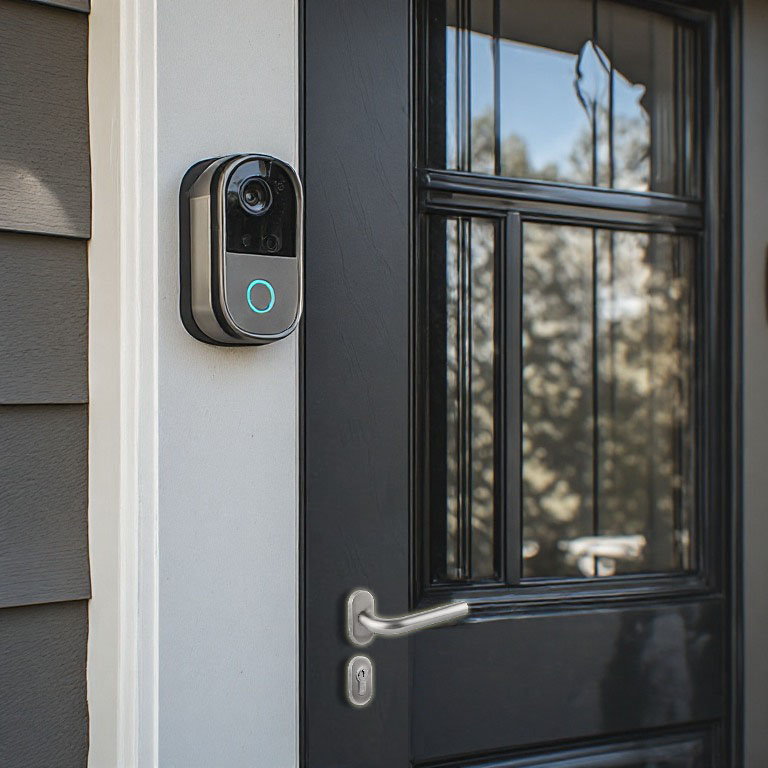
“Smart” doorbells, internet-connected devices that use Wi-Fi. They're video doorbells that replace the traditional ones. They allow you to view, listen and talk from a mobile app in real time, with people knocking at the door of the home, sending a live video signal and alerting the phone app when the call button is pressed or the motion sensor is activated.
EUPHEMISMS PROMOTED
- Visual verification and motion detection: Sends alerts when someone approaches the door to see who is before opening.
- Two-way communication: Talk to visitors without opening the door.
- Packet alerts and monitoring: Some models can detect and record when deliveries are made to the door.
- Deterrent: The presence of a camera often discourages intruders.
- Video evidence: the recorded images can be requested by law enforcement.
- Live video feed with two-way audio.
- Night vision or in low-light conditions.
- Local and cloud storage: They record clips that they store in the cloud or local storage.
- Insurance discounts: Some insurers offer reduced rates for supervised bells
- "Intelligent" Integration - Works with "smart" locks, lights and voice assistants.
- Easy installation: Many run on battery and do not require wiring
PROVEN FACTS
- Limited field of visual range/static field of view: the viewing angle is fixed once mounted, leaving blind spots.
- Limited service life: Its duration ranges from 3-5 years before total battery wear orreplacement of obsolescence forces, compared to traditional imperishable bells.
- Risk of theft: Some battery-powered models can be removed from the wall very easily.
- Subscription Rates:
- There are a variety of "Smart Doorbells" brands that charge for cloud storage.
- Advanced AI features (such as 24/7 video recording) also require monthly subscription.
- Wi-Fi dependency:
- Poor Wi-Fi signal can result in delayed video, loss of alerts, or call errors.
- The need for the proximity of the gateway router for a stable connection is indispensable.
- Wi-Fi bandwidth - Continuous video streaming slows home network.
- False alerts:
- Motion sensors can be activated by pets, passing cars, or shadows, generating excess alerts and notification saturation.
- Installation requirements:
- Hardwiring models need existing bell wiring; battery models require frequent recharging.
- Power Supply:
- Some are battery powered (need recharging) versus other cabling models (constantly charged, may need existing ringing cabling).
PRIVACY COMPROMISED
Data Flow
| What specific data collect?: | What is the destination of the information and data collected? | |
| Video | HD/2K video of everything and of all in the entry door, including neighbors and passers-by. | Cloud servers operated by the manufacturer. Data retention between 30 and 180 days depending on the type of subscription. |
| Audio microphone | Captures the ambient sound of the door | Cloud storage, same as video storage |
| Motion Events and Timestamps | Time and place where movement was detected | Stored in the manufacturer's cloud. Also visible in the device application |
| Device and network data | Wi-Fi SSID, IP address, device model, firmware version | Sent to the manufacturer's servers |
| Facial recognition data (optional) | Some models offer AI-based personal/facial identification | Processed locally or in the cloud, depending on the brand |
| Account Details | Email, phone number, application usage patterns | Stored by the manufacturer |
- PRIVACY CONCERNS:
- Neighbors and third parties may feel uncomfortable and upset being registered. Storing data on cloud servers raises serious privacy questions.
- It is important and necessary to check data encryption and who can access your footage, before purchasing and installing these devices.
- KEY DATA EXCHANGE ISSUES:
- Requirement by law: Certain manufacturers have shared images with the police through warrants or subpoenas, sometimes without notifying the homeowner.
- Third-party access: By integrating with other "smart" home platforms, doorbell data can flow into a wider ecosystem, increasing the attack surface.
- Indirectly violated privacy of neighbors and third parties: Cameras can record neighbouring properties, sidewalks and public spaces, raising legal and social tensions
- Data gaps: Any material stored in the cloud is a potential target for hackers.
"Smart" doorbells
Reference:
