
Currently, digitalization has expanded to each and every area that shapes the lives of citizens. These voluntarily and seduced by attractive false slogans like "Easier, faster and safer" unconsciously choose to be part of this machinery that devours the usual and more convenient life forms.
The economy is no stranger to this transformation and e-commerce is something common everyday where countless buying and selling transactions are made through different platforms.
This modern economic system through the exploitation of digitalization has an ideal tool to maximize corporate profits and also provides them with improved control mechanisms that were previously impossible.
In this scenario of technology promoted and dominated by large companies and corporations, the act of "buying" has been redefined into a sophisticated form of perpetual rent in which consumer rights are quietly taken away. Let us remember the promoted video of the WEF (Word Economic Forum) where they clearly warned with mockery smiling face that, "everything would be rented" and that "You will have nothing...."
The main feature of digital platforms is their potential to collect massive amounts of personal data, analyse it and create profiles to trap consumers with advertisements and recommendation spreads. These algorithms are not designed to serve the consumer's interests much less to protect them; rather they are created to keep them "chained" to an eternal payment system; an original and well-armed trap.
Corporations make sure the consumer has the conviction to have infinite choices for themselves, but what they actually have is less control than ever over their privacy, finances and purchasing decisions.
E-Book Trap: Property Expiration
Nothing illustrates this modern deception more batlanty than the digital book market.
Buying an e-book can seem like a simple transaction. The consumer clicks on a button labeled "Buy Now" and after a few minutes the title of the desired book will be available in their "digital library".
Certainly, this is a simulated transaction, a true legal fiction in which a good is not being purchased but is being purchased for limited use. This is the purchase of a revocable permission granted by the platform, which is the real owner of the book that "allows" the user to access this content under rigid conditions imposed and strictly restricted.
The digital book, unlike the physical book, is tied to the platform that provides it. If it closes or changes the terms of use or service, or if the device becomes obsolete or outdated for some reason, the "purchase" quickly disappears into the air.
To perceive the weak situation in which the modern consumer finds himself, it is essential to know the difference between licensing and legal property.
By "buying" a digital book the user does not own that file for which he has paid. In accordance with the Terms of Use of certain platforms, "Content is licensed by the Content Provider." This means that the provider has not sold that content.
This distinction was hidden for many years. Some legislative changes have now been introduced that have established that digital sales platforms are explicit about the nature of these transactions by indicating on their purchase pages that users are "buying a license to use the content."
Property implies the totality of rights over the thing; including the right to resell or transfer. Licensing, on the other hand, only grants a temporary privilege of use and/or visualization. The consumer pays for the product but lacks the fundamental rights.
The risks of a licensed future
The change from "owner" to "licensee" introduces several disadvantages that consumers, at the time of purchase, are unaware of or disregarded.
- Loss of access. If for any reason the platform cancels a user's account, the user loses access to each "purchased" item; or if the service platform fails or decides to close, the user's library also disappears.
- The digital library is not inheritable. Because of this licensing system, digital libraries are not transmittable to the next generations as physical libraries can be. Access to the platform expires with the account holder and the digital library "dies" with its "owner ".
- "Evolution" of formats and devices Another risk or disadvantage is the constant "evolution" (updating) of formats and devices. This forces the user to enter an endless cycle of updates and renewals in order to maintain access to the content.
It is essential to recognize the traps of closed ecosystems, understanding the difference between a product and a license. That way the public can begin to push back against the erosion of their property rights. Meanwhile, the only way to truly own a book is by physically holding it in your hands.
The shift from ownership to licensing is not an evolution of technology; is a calculated business strategy designed to transform the act of buying into a sophisticated form of control that ensures that the consumer never stops paying and lives in eternal dependence.
With these new tactics of restrictions and impediments, a single and clear effort is evident, imposing a rigid and unwavering gag on knowledge and wisdom.
Destructive Scanning: Unlimited and Unscrupulous Ambition
It would seem that the greed of the expertocracy has not yet reached the desired limits in its ambitious career for total domination and control. A new strategy has been added to the list: destructive scanning. This is called the last method used, in this case to monopolize knowledge and wisdom in their hands.
Destructive exploration for AI training
This newly developed process, called destructive scanning, is a high-performance method for scanning bound volumes by physically disassembling them before scanning the image. For this process used and rare books are acquired, then the wires or glues that link the pages to each other and attach them to each other - are removed mechanically and then the pages are scanned at high speed to finish by shreding the original physical copies.
Unlike non-destructive methods that preserve the physical object, this process is irreversible: the original union is destroyed. The book cannot be reassembled.
These large amounts of physical books are acquired by leading artificial intelligence companies because developers are looking for "clean" data free of AI-generated content, to train large models of AI language.
The Process Steps
The workflow transforms a bound workbook into a digital file using a strictly linear mechanical process:
- By means of a precision cutter or an industrial guillotine the spine of the book is cut and removed leaving the book reduced to a pile of individual loose leaves. In some interventions, hundreds of books can be processed at once.
- High-speed analysis then occurs by inserting the loose sheets into an Automatic Document Feeder (ADF) attached to a high-speed scanner that processes large amounts of pages per hour. Contrary, nondestructive scanners are significantly slower. By removing the links - the internal structure that joins the pages - from the books, the "distortion of the ditch" (the shadow and the curvature near the spine) is avoided, which generates a result of more precise images without shadows.
- The following is the post-processing of the scanned images and the OCR file is generated. The pages are digitally matched in a single file in the original order.
- At the end of scanning, the loose pages are removed. Recent reports indicate that in certain AI training contexts, and TO ENSURE THAT ONLY DIGITAL COPY EXISTS, physical books are destroyed immediately after scanning. This practice has been recognized in recent legal rulings as "FAIR USE" as they prevent the simultaneous circulation of two copies.
The Justification of the Biblioclasty
One of the reasons given by the unscrupulous corporations, to justify the application of this "new method," (or rather this true sacrilege), is that the copies published prior to 2022 are works considered of first quality with knowledge of human origin and without artificial contamination of digital data sets with AI slop (AI trash).
In addition, this destructive methodology has the following "advantages" that justify this action:
- Being a faster method for mass digitization, it generates greater performance and is ideal for large catalogues, periodicals or surplus library collections.
- It generates greater profitability thanks to automation and speed, and consequently the cost is significantly lower compared to traditional non-destructive methods.
- The resulting images have higher quality and are free of distortion that favors better processing and recognition of text.
A beneficial and collaborating intermediary
These explore-destructive corporations, through intermediaries such as ISBNdb, place anonymous orders for exorbitant amounts of books that range from 1,000 to one million per transaction.
Who is ISBNdb?
ISBNdb is an institution that collects data and information from international sources and has created a unified global index of hundreds of libraries, publishers, merchants and other public sources to provide structured book metadata. This for-profit company manages the world's largest book database, offering a varied repertoire of millions of books that can be searched by
- ISBN,
- Author or Editor,
- Title,
- Publication Date,
- Topics,
- Prices and covers,
- Physical Specifications:
- Binding, Number of pages, Weight, Dimensions.
The data are constantly updated, also gathering information on used, rare and non-printed titles and in various languages.
ISBNdb's customer portfolio includes:
- Booksellers and online retailers
- Libraries and educational institutions.
- Software developers.
- Artificial intelligence and machine learning equipment.
"FAIR USE" an advantageous legal precedent
Recently a technology corporation that created an AI model has been identified as a central figure in this destructive scanning practice. Internal documents, from that company that have transcended, have revealed the expense of tens of millions of dollars to acquire millions of books.
But the most relevant fact of this story is not only the fact of destruction itself; a reprehensible act for itself, but also this is aggravated by the explicit interest of the company in maintaining this methodology used in a STRICT CONFIDENTIALITY. This claim of silence is because the destruction of books is not a fact that public opinion accepts as something indifferent and obviously transcending and knowing the news would generate justified rejections.
However, to greater astonishment and contrary to what any person of good might believe, recently a court has set a legal precedent by issuing a ruling in favor of this methodology; arguing that the destructive scanning of legally acquired books constitutes fair use.
In addition, the court stated that this process was "par excellence transformative" because it converted physical texts into digital data for modeling.
Impact on rare books and cultural heritage
This action has triggered alarms about the loss of cultural heritage and has sparked ethical debates because physical originals are destroyed after scanning unlike traditional digitalization projects that preserve physical volumes.
Critics have raised their voices to warn that this industrial-level destruction prioritizes data mining over preservation. There is also an obvious and serious risk that single, rare or low circulation editions will disappear completely from the public sphere, leaving digital scanning as the only surviving version; which inevitably leads to an "Erasure and Oblivion" where human knowledge is left in private hands and under the exclusive control of the owners of AI model corporations.
Deliberately restricting access to books and reading is one of the most widely used social control tactics. By erecting barriers to knowledge, a functionally illiterate and ignorant citizenry is shaped, incapable of questioning, contradicting or revealing itself against oppression, tyranny, domination or authoritarian control.
The deliberately covert censorship, evidences the clear intention to nullify the critical capacity of the masses, transforming citizens into passive, submissive and predictable consumers. Mass ignorance thus fostered becomes the ideal ground for the emergence of tyrannies and totalitarianisms that would otherwise be unsustainable with an informed and thoughtful population.
Erasing or rewriting history has always been the supreme goal of every totalitarian regime. Altering actual facts to fit a convenient narrative is not a new phenomenon. Today we are witnessing a new phase of this old purpose: the systematic replacement of the physical book by the digital format.
The physical book represents much more than a simple set of bound pages; it is an evidence, a constancy and a palpable and "living" proof of facts, ideas and events that have happened.
Over the centuries, tyrants have understood this perfectly. The attack on printed knowledge has been the preferred tool of those seeking to control thought. In ancient times, mass destruction of physical books required great effort; public bonfires, raids and burnt cellars were the tactics used to demonstrate the oppressive nature of the censor.
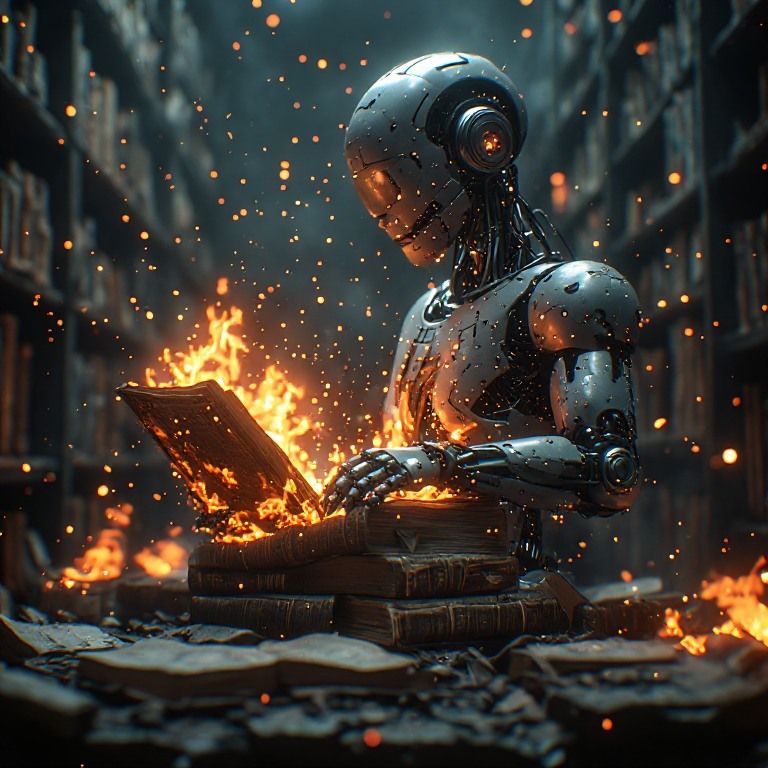
Today, totalitarianism has found a much clearer, faster and more effective way: DESTRUCTIVE SCANNING. This is the new strategy used to erase history or rewrite it, replacing physical books absolutely with digital books.
Digital files can be edited stealthily, rewritten between one edition and another without a trace, censored by algorithms, or can disappear completely by just pressing a key.
If a central server decides that a passage is "offensive," that it contradicts the official narrative or that it simply no longer conforms to the standards of the moment, the modification is applied globally and automatically, and the next day the altered version of the work arises, without the content of the original text ever being known.
Now, by accelerating the disappearance of physical books they have decided to go one step further towards that totalitarian long awaited goal. It is no longer just a question of banning uncomfortable readings, but of eliminating the very support that guarantees the permanence of critical thinking. If we allow the physical evidence of our history and culture to be erased under fallacious excuses and acquittal judgments, we will not only lose our books, but lose the right to remember the truth.
A world without printed books is a world without memory, a perpetual present where history adapts to the convenience of those in power. Every book that remains closed or is destroyed represents a consciousness that will never awaken.
Ultimately, to hinder and impede access to reading is to openly confess the terror that every tyrant feels before a liberated mind.
HIJACKING KNOWLEDGE AND WISDOM
https://reimaginings.substack.com/p/you-dont-own-the-e-books-you-buy
https://www.reddit.com/r/kindle/comments/17kp23v/you_dont_own_the_ebooks_you_buy_on_amazon_kindle/
https://goodereader.com/blog/kindle/amazon-changes-licensing-text-when-kindle-books-are-purchased
https://futurism.com/artificial-intelligence/ai-companies-destroying-rare-books