
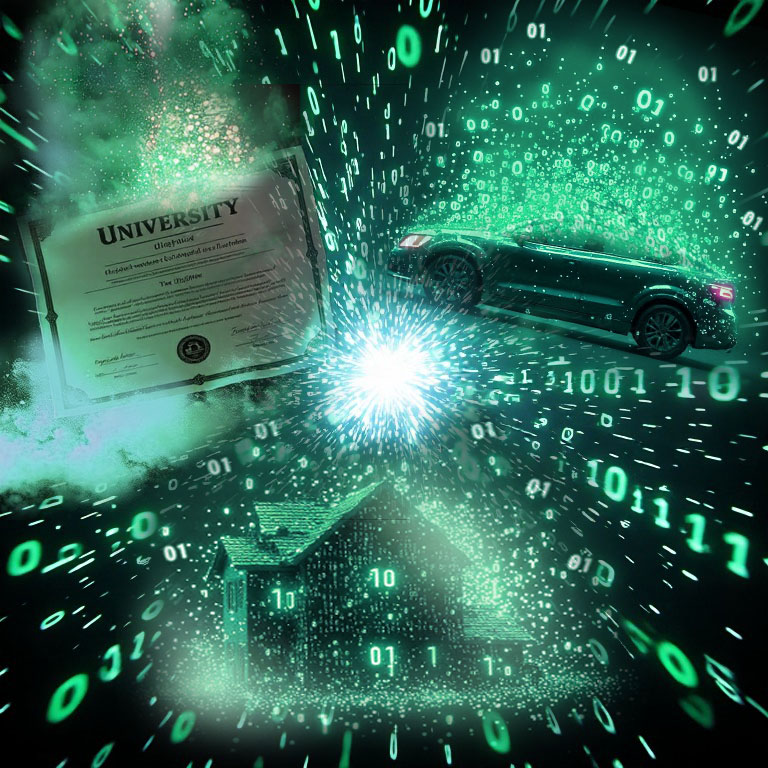
Technological progress has been defined as an economic process of innovation that allows to positively impact the growth of countries by driving increases in productivity by developing better methods for obtaining goods and services.
Consequently, in society it is considered and perceived as the main engine and the effective means to achieve better standards in the quality of life.
In this context there is a widespread belief in popular ideology, that the ultimate goal of technological innovation seeks exclusively human benefit and well-being. This axiom legitimizes this technological advance, so if it were not perceived as a welfare tool, it would lose its massive social support.
However, not all that shines is gold.
While on the one hand technology acts as a driver of development, on the other it challenges the naturalized notion that technological advancement automatically guarantees social well-being.
The disconnect between technology and social welfare
Despite its efficiency and benefits that generate wealth, there is a total and growing disconnect between technological progress and real social progress. Contemporary analyses indicate that technology is not neutral and that its impact depends directly on the institutions and power structures that direct it.
Operating under the exclusive control of power groups, automation and artificial intelligence exacerbate inequality, concentrate wealth in few hands and erode fundamental rights by creating a remarkably fragile, dependent and absolutely controlled system.
In this sense, technological progress is only favoring large corporations and, meanwhile for society the list of disadvantages increase every day:
- Violation and systematic erosion of privacy. The ubiquitous surveillance and massive collection of data by corporations and governments has normalized the loss of privacy, allowing social control and manipulation on an unprecedented scale.
- Limitation and/or loss of individual rights such as freedom of expression and mobility.
- Loss of legal certainty and real property through tokenization.
- Displacement of work and massive detriment of traditional employment, especially in manufacturing, transportation and service sectors where automation and AI displace workers faster than new jobs are created.
- Environmental costs. Contradicting claims of "green" agendas, the technological progress imposes a heavy ecological burden:
- Energy consumption and water resources. The technology industry grows rapidly and with it, energy and water requirements for maintenance grow exponentially.
- Proliferation of electronic waste. More than 53.6 million tons of e-waste are generated globally by the planned obsolescence cycle. Only a fraction is recycled; the rest filter toxic materials such as lead and mercury into soil and water, causing consequent environmental and health damage.
- Depletion of resources: The manufacture of devices requires elements of rare earths, for which destructive mining practices are promoted that degrade habitats, ecosystems and consume large amounts of water.
The implementation of AI introduces disadvantages and risks that challenge social stability, security, privacy and human freedom, and the balance and preservation of natural resources by creating new threats that were theoretical and unthinkable just a few years ago.
The End of Possession and Ownership
One of those forced digital changes that evidences this transformation and that directly affect citizens is the move from owning to simply being a licensee or user.
In any traditional physical format the object is possessed and therefore its owner can lend it, sell it, modify it or read it freely. In the digital environment, on the contrary, only licenses or access keys subject to terms and conditions that may change or be revocable overnight are acquired.
Digital documents a property rights, face a programmed obsolescence, accelerated technological expiration. Outdated and unread files due to modifications in the base software, degradation of storage media and an absolute dependence on specific hardware are important disadvantages present in digital formats.
A university degree or deed saved in digital format is at constant risk of becoming unreadable or worse than disappearing and being completely lost.
In contrast, a physical document, can be stored and last for centuries, remains readable without the need for electricity, internet or proprietary software licenses.
Significant Risks of University and Property Digital Degrees
Digital University Degrees
The main disadvantages of digital university degrees are:
- Legal and regulatory uncertainty: There is a legal ambiguity as to whether the "authentic electronic copy" has exactly the same executive validity as the traditional physical title in all procedures.
- Security and privacy vulnerabilities. Digital diplomas are susceptible to phishing attacks and sophisticated counterfeiting if the underlying verification infrastructure is compromised. In addition, data privacy may be at risk, as the verification process may require and expose more personal information than is necessary.
- Another latent risk is fake portals that can be created by imitating legitimate verification sites to steal personal data. In addition, if a user's private keys or digital wallet are lost or hacked, access to the credential may be permanently lost; unlike a physical paper document that once issued remains in the owner's possession regardless of the state of the server.
- Dependence on technological infrastructure: The validity of the title depends on the permanence of the broadcasting platform.
- The obsolescence of servers: If the university or national registry that guards the data changes its computer system, or the institution closes or goes bankrupt for some reason, or suffers a massive attack, the verification of the title is temporarily or permanently disabled.
- Depersonalization and symbolic value. The absence of the physical diploma reduces the ceremonial and emotional value of academic achievement for many graduates. The impossibility of framing a tangible document or physically displaying it in an office without depending on a screen is perceived as a significant cultural disadvantage.
Digital Property Titles
In the case of ownership of immovable or movable property (especially when tokenized or registered in blockchain), digital property securities face much more critical risks that may result in the ultimate loss of the asset, representing the total loss of the royalty. For this reason they face higher stakes due to the immense financial value of real estate and the complexity of legal frameworks.
- Irreversibility due to loss of keys. In systems of decentralized digital ownership or based on private key cryptography:
- If the holder loses their private key, there is no centralized "customer service" that can restore access. The asset is locked indefinitely. Loss of Access is equivalent to Loss of Ownership.
- Digital property titles are extremely vulnerable to being high-value targets for hacking, phishing and malware. Once fraudulently transferred, legal recovery is extremely complex and practically impossible.
- Volatility and speculation. If the title is linked to a token or cryptoactive:
- Value instability. The market value of the "title" can fluctuate dramatically due to speculation, regardless of the real value of the underlying asset.
- Platform risk. If the market or platform where digital ownership is managed closes (as has happened with several exchanges and NFT markets), users lose the ability to easily view, transfer, or demonstrate ownership, even if blockchain registration persists.
- Complexity in hereditary succession.
- The transmission of digital properties after the death of the holder is a legal and technical vacuum.
- Without a mechanism for heirs to access keys or prove their right to a decentralized registry, ownership may remain in legal limbo, unlike traditional property registers that have established notarial procedures for inheritance.
- The problem of "garbage inside, garbage outside." A critical risk in digitizing land records is the persistence of errors. If historical physical records contain errors or ambiguities, uploading them to a blockchain cements these errors forever. Fixing a blockchain error is significantly harder than modifying a paper ledger.
- It also faces challenges related to legal frameworks, interoperability between different land registries, and the need for robust measures to protect against digital theft and identity theft.
Unlike paper records that require physical access to alter, digital records can be compromised remotely.
What does blockchain mean?
Blockchain (or blockchain) is the infrastructure that allows the existence of "secure" digital assets (such as cryptocurrencies, NPs, or digital title titles). It is a distributed registration technology that works in a decentralized manner and as a digital ledger. Unlike a traditional database controlled by a single entity (such as a bank), blockchain stores information on thousands of computers simultaneously.
It is promoted as "immutable or practically impossible to alter or hack" without network consensus. But saying "practically impossible" recognizes that blockchain is tamper-evident (evident to manipulation) but not magically indestructible. This phrase of "practically impossible" is used because technically, there is no 100% mathematical certainty that a blockchain is unchangeable. Security is not absolute. Therefore immutability is only propaganda.
Existing theoretical and practical scenarios where that "certainty" can be broken:
1. The 51% Attack (Economic Viability)
Immutability depends on no actor controlling most of the computing power (hashrate) of the network. If an entity manages to control more than 50% of the network, it can rewrite recent history, duplicate expenses, and alter records.
2. The Threat of Quantum Computing
This is the most significant risk to 100% certainty. Quantum computers could run algorithms capable of breaking public key cryptography (ECDSA) that "protects" wallets and digital signatures. Specialists in the topic warn that the "immutability and security" of assets will be compromised in the coming decades.
3. Reorgs and Software Errors
Even without malicious attacks, blockchain can undergo modifications:
• Reorgs: Occasionally, due to network latency or software errors, the string can be "rearranged," discarding valid recent blocks. This shows that the record is not instantly immutable.
• Bugs and Forks: Critical code errors (such as the 2010 overflow incident that generated trillions of fake BTC) have forced the community to make "hard forks" to reverse transactions and correct history; which brings to light the fallacy of "immutability."
Therefore, confidence in blockchain is a bet based on economic incentives and current cryptography, not an unwavering physical law.
How does blockchain work?
The process is based on grouping information into "blocks" that are linked chronologically:
1. Transaction: An operation is requested (e.g. sending money or registering a title).
2. Validation: The computer network (nodes) verifies that the transaction is legitimate using consensus algorithms.
3. Block: Validated transactions are grouped into a block that includes a timestamp and a unique cryptographic code (hash).
4. Chaining: The new block is joined to the previous block by its hash, forming a chain.
The End of physical documents and the Beginning of Control: The Forced Global Digitization of Registers and the Legal Disprotection of Citizens
However, despite all these disadvantages and risks, governments around the world, in strict compliance with global digitization agenda directives imposed by supranational entities and powerful corporations, have made accelerated progress towards the deletion of physical records.
With the argument of modernization and behind promises of efficiency with which they present and promote this profound transformation, the paper is being replaced by digital documents that are endowed with full legal validity, turning traditional paper formats into obsolete relics.
This transition establishes an insurmountable entry barrier for the population. Those who are unable or unwilling to use digital tools suddenly find themselves without alternative options and are forced to submit to the mandatory use of digital certificates or mobile applications to perform essential procedures, making their theoretical rights inaccessible in practice.
These de facto and unaltered impositions generate unprecedented legal disprotection, which translates literally and directly into the loss of all the guarantees, rights and freedoms that have historically defined the concept of citizen.
The motto "You will own nothing and you will be happy" is a clear and precise description of the socioeconomic model towards which the technological concentration in corporate hands pushes us with the obsessed complicities and collaboration of governments and states.
Blindly accepting that these innovations amount to "progress" leads to a scenario of total loss of rights and extreme vulnerability.
The Physical Documents Elimination Map: The Global Pioneers
Several countries are fast approaching this model of digital governance. The most prominent cases worldwide are:
1. Estonia: The World Digital Identity Standard· Global Voices
Estonia is considered the most advanced nation in government digitalization. More than 98% of its public services - including identity and property records - operate exclusively in digital environments.
• Property: The real estate registry is managed by blockchain technology. There is no concept of a "physical title"; digital registration is the only and indisputable option.
• Education and Procedures: Diplomas are issued digitally and electronic identity (e-ID) has completely displaced the need to present physical credentials for civilian life.
2. Argentina: Innovation in Educational Degrees·
The City of Buenos Aires leads a pioneering model in the region through the Digital Education Degree System. These documents have immediate legal validity, are authenticated with QR codes and are issued exclusively in electronic format, suppressing the traditional diploma. At the national level, the country is progressing gradually towards the digitization of property registers, although both formats still coexist.
3. Spain: Commercial and Digital Property Registries
Spain has completed a significant goal in the digitization of its public registers (property and commercial registers). Although citizens can apply for physical certifications for information, the original legal document is exclusively electronic. Real estate and vehicle transactions are conducted telematically between notaries and registrars.
4. Other Nations in Advanced Transition
• Austria and New Zealand: Show a strong commitment to the removal of physical records. In New Zealand, property titles operate under a digitized Torrens system where physical documents are a marginal exception.
• Uruguay: Positions itself as a leader in Latin America in the digitalization of documents including property procedures, minimizing the intervention of physical media.
The Illusion of Progress
At first glance, the elimination of physical documents is presented as a triumph of technology over bureaucracy. However, practical reality reveals a structurally unfavorable balance seriously compromising individual sovereignty and historical preservation.
Technology has ceased to be a neutral instrument of progress to become an ideology dominated by algorithms and managed by experts under the banner of "efficiency."
Technological progress has not liberated the consumer or given him greater well-being; instead, have replaced the tangible property with a conditional license.
A physical book or university degree on a physical document is perpetual property that remains under the sole control of its owner. Their digital equivalents, on the other hand, are revocable accesses, conditioned on the survival of a supplier company, the validity of a technological standard and the absence of remote censorship.
Unlike physical documents, the digital information suffers from constant obsolescence in both hardware and software. Paradoxically, the so-called "information age" without limits exposes current populations and future generations to the real risk of total loss of access to critical legal and historical documents simply because the codec, platform or support needed to read them ceased to exist.
The definitive suppression of physical support consolidates a model based on dependence and surveillance. By centralizing historical and legal truth into algorithms and databases managed by tech intermediary absolutists; the State, governments and these same corporations acquire an unprecedented capacity for control over citizens.
In this scenario, digitalization does not represent an advance towards freedom and progress but a regression in legal security and personal autonomy, where actual possession is gradually diluted in favor of conditional, monitored and subject to the constant authorization of external systems.Thus preserving and protecting the independence and personal autonomy is an essential act for the defence of individual rights.
You own nothing... and you will be digital
https://seekingalpha.com/article/4939886-how-ai-reshaping-global-economic-outlook
https://www.oitcinterfor.org/en/digitalizaci%c3%b3n/technological-unemployment
https://students.ucsd.edu/academics/advising/degrees-diplomas/digital-diplomas.html
https://www.bcdiploma.com/en/blog/a-quoi-sert-un-diplome-numerique-2021-02-09
https://www.apd.es/aplicaciones-blockchain/
https://buenosaires.gob.ar/gcaba_historico/educacion/sistema-de-titulos-educativos-digitales