
In the collective imaginary, the idea that technological advances are, by definition, an unequivocal synonym for improvement in people's living standards prevails. Computer science, automation and artificial intelligence (AI) have been massively marketed and presented as the universal solution to solve the most complex problems of an increasingly demanding humanity.
It is undeniable, however, that this accelerated technological progress also entails disadvantages. If you look at reality with attention, beyond the attractive corporate decor and the promises of marketing.
Those who advocate these changes are very clear about their aims, and these are not exactly humanitarian objectives for the common welfare. On the contrary, the purposes that encourage them respond to severe agendas of global control, domination and subjugation.
These dizzying technological advances are facilitating the construction of a dystopian world in which the ordinary citizen will be trapped without rights, without fundamental freedoms and with the absolute impossibility of returning to a previous state of autonomy. Day after day, subtle changes and modifications are negatively transforming daily life, even though few people can perceive the magnitude of this transformation.
Artificial Intelligence and the beginning of the end of traditional employment
The massive application of Artificial Intelligence in all spheres of human existence is far from being only a tool of support, it constitutes the beginning of the end for countless professions, trades and occupations in which the human being will be indefectibly replaced by algorithmic systems.
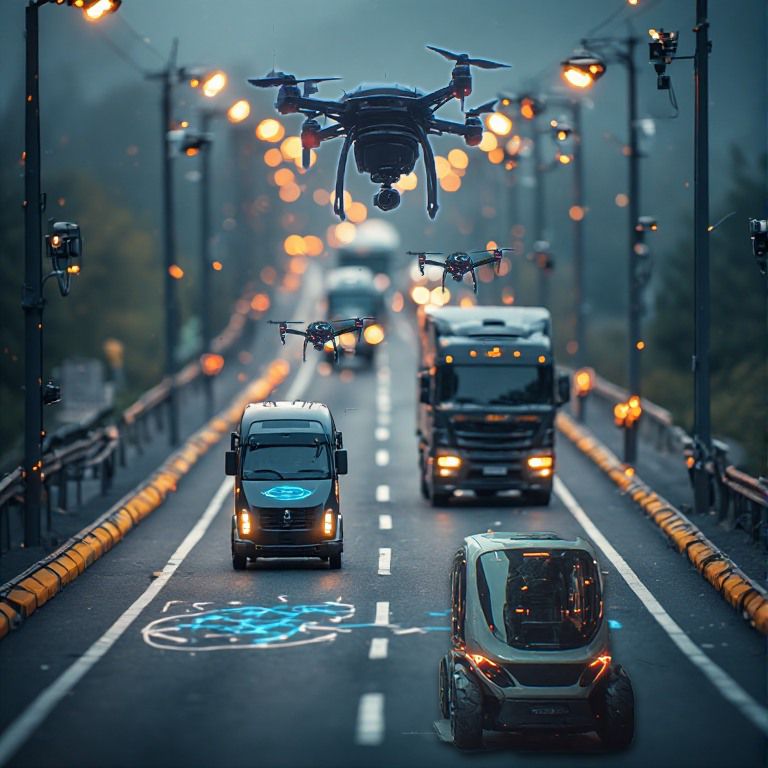
The implementation of fully automated heavy transport fleets its a clear example of these adverse changes. In May 2025, a key point in this direction materialized at a coal mine in Inner Mongolia, China, where an initial fleet of 100 unmanned electric trucks was deployed.
These vehicles are equipped with state-of-the-art autonomous driving systems, using 5G-A communications (5.5G), advanced artificial intelligence, cloud computing and intelligent systems for automated battery exchange.
Industrial projections do not stop there: the objective within three years is to expand the fleet to 300 trucks on the same site. In addition, sector estimates project that China would operate a total of 10,000 automated mining trucks this year.
This gigantic deployment of an autonomous car fleet immediately leaves thousands of drivers and drivers in a state of total labor helplessness, drastically reducing the supply of jobs in the sector.
The logistic expansion and the emergence of the "Robovans"
Long-haul commercial freight operations using autonomous trucks have experienced exponential growth throughout China. In August 2024, an industry firm deployed 400 autonomous heavy-duty trucks, marking the world's largest delivery of intelligent transport trucks.
As a general unwavering rule, industries leading the development and mass deployment of these technologies prioritize the radical reduction of labor costs; and minimize the massive loss of jobs that originates when a human worker is replaced by a machine.
Despite the social cost, the expansion progresses without pause and thousands of autonomous vehicles already navigate daily through complex urban environments.
What is a Robovan?
A robovan is an autonomous, most of them electric... and designed specifically to operate without any human intervention.
Defining characteristics:
- Operational: They are built for continuous operation 24 hours a day, 365 days a year, under various adverse weather conditions.
- Profitability for capital: They have a determining characteristic for corporations: they do not need wages, breaks, social security or labor rights.
- Capacity: Unlike standard robotaxis, robovans are usually larger, with the capacity to carry significant loads or up to 20 passengers.
Global Landscape vs. Autonomous Vehicles
The Asian market, particularly the Chinese one, is characterized by a rapid and aggressive escalation in this sector. China stands today as the unquestionable leader in the distribution and deployment of robovans. Technology for operational operation is already active in hundreds of metropolises; cities like Qingdao have more than 1,200 automated vans circulating actively.
In contrast, in the United States, deployment develops in a more cautious, geofacial and test-prone manner. A major technology company plans to launch its autonomous services in the states of California and Texas, but continues to await final regulatory approvals.
For their part, nations such as the United Arab Emirates, Japan and South Korea actively promote the deployment of robovans, fully joining this technological career. Countries such as Australia, Germany, Switzerland and Turkey have announced concrete plans to launch robotaxis and robovane services, while pilot tests are conducted in territories of France, New Zealand, Norway, Singapore and Sweden.
Critical Challenges of Autonomous Technology
Despite corporate enthusiasm, this technology faces serious structural challenges that call into question its short-term viability:
- Safety and reliability: It is one of the most visible deficiencies. Numerous viral videos have exposed serious operational failures, showing Robovans battling poor road conditions and demonstrating a worrying inability to detect unforeseen road obstacles.
- Regulatory compliance: It is another important bottleneck. In complex jurisdictions such as the US, policy guidelines at the federal level continue in lengthy discussions without a definitive framework.
- High development costs: The enormous economic investment required has forced some major industry players to permanently reduce or cancel their autonomous vehicle projects.
- Socio-economic risks: The widespread adoption of these alternatives threatens to deeply shake the labour economy. Millions of human drivers face the uncertainty of losing their livelihoods by being displaced by cheaper automated options managed by artificial intelligence.
Towards "Smart Cities": The Ecosystem of Dependence
The future prospects of the autonomous automotive industry unequivocally point towards exponential growth and full integration with the infrastructures of so-called smart cities. Sector estimates predict that by 2030, about 15% of global urban transport could be completely autonomous.
There is a direct and absolutely dependent relationship between these Smart Cities and Robovans. These vehicles cannot operate in a digital vacuum; They need the massive connectivity of 5G networks and the dense integrated infrastructure of IoT sensors (Internet of Things) in urban areas to be able to move around. Without this complex ultra-low latency communication infrastructure, mass autonomous driving is no longer viable.
The promise of an automated future under the umbrella of artificial intelligence and smart cities hides the substitution of the human factor in the global economy does not represent a natural evolution towards social well-being, but the consolidation of a technocratic model of corporate and technological control where the freedom and sustenance of the individual are subordinated to the efficiency of the machines.
The Digital Panopticon: The Truth Behind Smart Cities and Global Technocratic Control
Urban development has undergone a radical transformation in recent decades. What was presented as a natural evolution towards modernization, sustainability and ecological efficiency, is a system of social engineering and population control. The so-called Smart Cities are no longer a hypothesis of science fiction, but a reality that unfolds in an accelerated manner in the major metropolises of the planet.
Beneath a façade of modernity, connectivity and apparent well-being, exist a composed of state-of-the-art technologies such as robotics and "intelligent systems" that collect, analyze and act on real-time data. However, the infrastructure and the digital agenda exposes the replacement of individual freedoms by a model of mass surveillance, restriction of mobility and expertscratics tyranny.
What really is a Smart City?
Officially, a Smart City is defined as an urban environment that uses information and communication technology (ICT) to improve the quality of life of its inhabitants, optimize the use of resources and reduce the environmental impact. However, this institutional definition hides the true nature of infrastructure.
For a city to be considered "smart," it requires a ubiquitous data collection network. This is not limited to digitization of government procedures or efficient traffic management; it involves the exhaustive monitoring of every movement, consumption, interaction and behavior of citizens. The city ceases to be a public free transit space to become a hyper-regulated platform where each inhabitant is a data node managed by algorithms.
Enthusiasts of this model argue that automation will solve the chronic problems of large cities. But the architectural and digital reality of these transformations points towards the consolidation of a centralized control system, where the sovereignty of the individual is subordinated to the guidelines of technocrat planners.
The Concept of the "City of 15 Minutes": ¿Convenience or Confinement?
One of the fundamental pillars in the narrative of contemporary urban planning is the concept of the 15 Minutes Cities. Popularized recently and implemented in various European and American capitals, this model fosters an urban environment where essential services for people's lives - such as health centers, schools, shops and work areas - are accessible in a short radius on foot or by bicycle that takes no more than 15 minutes.
At first glance, the premise of having everything around can seem attractive and even nostalgic, evoking traditional neighborhood life. However, a thorough and careful analysis reveals that this proposal is essentially a strategy of geographical restriction.
In addition to the obsession to reconfigure the social fabric, enthusiastic technocrats and Smart Cities supporters yearn for the ultimate suppression of the private car. This is one of their main objectives to be achieved. The elimination of private transport does not meet environmental criteria alone, but a tactical need for control: a citizen who relies exclusively on pedestrian mobility, bicycle mobility or highly regulated public transport is an easily confined citizen.
The Technological Pillars of Digital Prison
The infrastructure of a Smart City is not only based on good intentions or mobility policies; it requires unprecedented technological deployment that acts as the foundation of what many critics call modern gulags, panopticons, or digital prisons.
The key points underpinning these infrastructures are:
- The Internet of Things (IoT): IoT consists of a massive network of sensors and connected devices that measure absolutely every aspect of people's lives. From smart meters in homes that record energy consumption patterns to sensors on sidewalks that count pedestrian flow, nothing escapes data capture.
- Artificial Intelligence (AI) and Big Data: The huge amount of data collected by IoT would be useless without the processing capacity of Artificial Intelligence and Big Data. Advanced algorithms are responsible for processing these massive volumes of information in real time, detecting anomalies, predicting behaviors and making automated decisions that directly affect the population without the intervention of a judge or a democratic process.
- Digital Twins: Digital Twins are exact virtual replicas of urban infrastructure and its inhabitants in cyberspace. These models simulate complex scenarios and allow managers to predict social reactions, traffic flows, or responses to crises.
- 5G Connectivity: The 5G network is not simply an improvement in mobile navigation speed for the ordinary citizen. It is a critical infrastructure of high speed, low latency and high capacity, essential to support the density of connected devices and enable instant communication between sensors, facial recognition cameras and data processing centers.
- Automated and Robotic Systems: The application of robotics and automation in smart buildings, traffic lights, public transport and basic services ensures that urban management operates without the need for empathic human personnel, operating under strict binary parameters of compliance or infringement.
Impact on Daily Life: Monitoring and Limiting Mobility
The implementation of these systems has a negative, direct and tangible impact on the daily routine of the inhabitants, gradually stripping them of their autonomy.
Limited Mobility and Geofencing
Under the justification of urban optimization, citizens are controlled and monitored in real time. With the use of geofencing technologies (virtual geographic fences), people can be limited to moving only within the radius of the 15 minutes allowed.
Every individual shall be limited and shall remain in his or her designated area with no possibility of exceeding this assigned area without prior authorization. Exact geolocation at every moment of the location of each and every person will allow technocrats to apply automatic sanctions.
Among the most feared coercive tools is the ability to cancel or suspend the "social credit" or the CBDC (Digital Currencies of Central Banks) assigned to the citizen, making it impossible to carry out transactions if it is beyond the authorized limits or if its behavior does not align with the official guidelines.
Constant Monitoring and Monitoring
Urban video surveillance systems, equipped with facial recognition and advanced artificial intelligence, together with central monitoring centers, are the fundamental tool of this new concept of city-prison. Through these technologies, people are identified, registered, tracked and controlled 24 hours a day, completely eliminating the fundamental right to privacy and freedom of movement.
The Global Deployment of the New Panopticon
The implementation of these smart prisons is not an isolated phenomenon, but a coordinated global process. Political leaders, international organizations, technology corporations and technocrat bureaucrats are deploying these infrastructures in various cities around the world at an accelerated pace.
Making arguments of sustainability, security, energy efficiency and other euphemisms carefully designed to deceive public opinion, they build the panopticon in which they intend to enclose the entire humanity.
The paradoxical thing about this model is that the architects and promoters of these policies will obviously be exempt from these impositions, keeping their freedom of movement and their privileges outside the controlled perimeters.
Towards a Civilizing Crossroads
Smart Cities, autonomous vehicles (robovans), virtual fences (geofencing), digital currencies (CBDC) and Digital Identification systems are not disconnected technologies. They are components of the same integral structure.
These are parts of a whole that has been planned, financed and programmed to imprison citizens within these new and original futuristic prisons. In this new urban order, freedom becomes a conditioned privilege: a few will enjoy full rights, while the vast majority of the population will be relegated to an existence of obedience, algorithmic control and strict compliance.
Understanding the true nature of Smart Cities is the first inescapable step in resisting a model that threatens to eradicate human autonomy and transform public space into an open digital concentration camp.
Beyond progress: Where does automation and artificial intelligence lead us?
https://futurism.com/advanced-transport/robovan-china-delivery
https://www.automotiveworld.com/articles/autonomous-trucks-are-taking-off-in-china-is-europe-next/
https://www.hp.com/mx-es/shop/tech-takes/ciudades-inteligentes-e-inteligencia-artificial
https://www.reddit.com/r/Life/comments/1jkk0cx/hows_life_when_living_in_a_city/?tl=es-419